assertiveness

Feedback on How to Be Angry from Elementary School Students

0

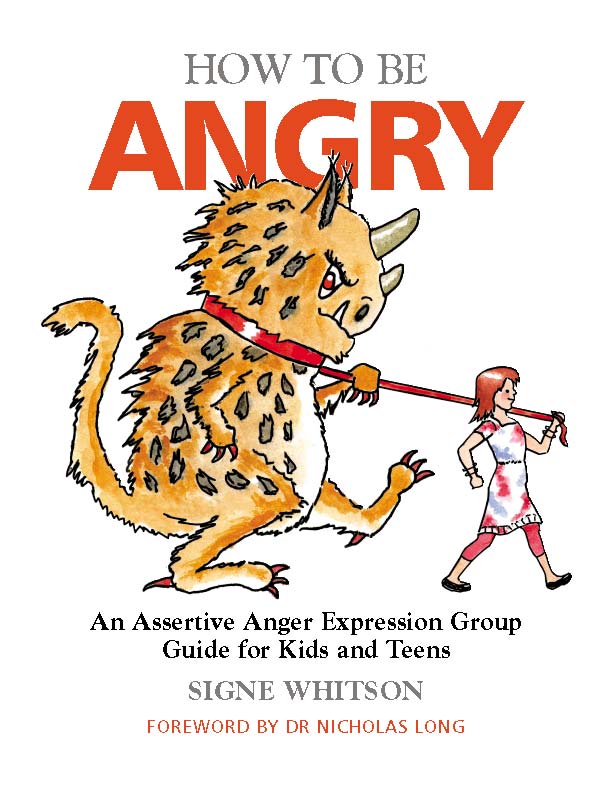
Six students from the Freetown Elementary School in Maryland recently completed the How to Be Angry curriculum.  They were kind enough to share with me their feedback on the activities, lessons, and games and gave me permission, in turn, to share it with you!  Special thanks to Aimee Meyer, their teacher who led the lessons, and all of the kids who are such gracious and enthusiastic learners!


Most important thing I’ve learned so far …

  •   ”Bullies are not cool.”
  •   ”I learned how to use I messages instead of you messages all the time.” 
  •   ”I learned about passive-aggressive behavior.  That’s what I do.” 
    • When prompted for more information, the student said “You know, like when I mope around, shuffle real slow down the hall, soft-talk and work real slow or not at all.  Now I know how to calm down better.”
  •   ”I learned that you don’t have to take things out on someone else all the time.  I only knew how to do that.”


What I have enjoyed the most about these lessons …

  • “I liked when we did the activity with putting magnets underneath the types of anger. The magnets told us what the types of anger looked like and what we could do when we feel these.” 
  • “I’m moving to different parts of the room when we gained our opinions to something. We learned how to respect others’ opinions and that it’s okay to have different opinions.”
  • “I really liked the game where we lined up by our birthday but we couldn’t talk. It was hard and we had to use our hands, fingers and faces to do it.  We learned about nonverbal communication. It’s important.”
  • “I liked how there were a lot of games. There was one at the beginning of each lesson and they were pretty fun.”


If I could improve on this book in one way I would …

  • “Add more games. They are a lot of fun and active.”
  • “Give the kids a workbook so they each have their own.”
  • “Add pictures and colors to the worksheets or a Kid’s Workbook.”


Note for Educators:  Handouts for kids in How to Be Angry are reproducible!  You may feel free to make kids their own workbook to use as you are conducting each session.  The kids recommend it and so do I!


Thanks again, kids!


All the best–                                                                                                                                                                                                                                                                                                           Signe

I Wish I Could Have a Do-Over! 5 Strategies for Parenting with a More Level Head

0

Not long ago, my daughter, her best friend and I had a full day’s worth of activity and adventure, enjoying carnival games at a local festival, eating bags of salty popcorn, running through icy cold fountains when the day’s heat became too intense and following it all up with a late afternoon movie. It was Girl Time at its best!

Which is why I was totally blown away when, after dropping off her friend, my daughter’s answer to my innocent inquiry of, “So, what should we do for dinner?” was met with a raging, “Nothing! Can we just go home already? I think we’ve bonded enough for one day.”

“Was that a car that just rear-ended me?” I thought momentarily. “Can words cause whiplash?” I wondered. My white knuckles clutched the steering wheel with primitive force and I’m pretty sure the woman in the lane next to me witnessed steam coming out of my ears.

“Seriously?” I started out calmly. Unfortunately, I only began that way. Quick as a flash, angry words of hurt and indignation rang forth from my mouth. I promised to never take my daughter anywhere… ever… again. I threatened to cancel our “bonding plans” for next weekend’s end-of-school-year trip. I lied and told her that I had had a miserable day, too. In short, I mirrored the emotions my daughter had just unleashed on me and fueled the out-of-the-blue conflict with ten additional gallons of gasoline. When my rant was over, I looked at her in the rearview mirror and I knew I had blown it.

For the rest of this not-so-Mom-of-the-Year-moment–including my thoughts on how I would approach this situation if I could have a Do-Over–please check out my full article in the HuffingtonPost:

http://www.huffingtonpost.com/signe-whitson/anger-management_b_1564608.html?ref=parents


Please also check out the tab on LSCI Skills for Parents training, for more information on de-escalating conflicts with kids and improving parent-child relationships.

Enter to Win a Free Copy of Friendship & Other Weapons

0

Enter to win a free, signed copy of Friendship & Other Weapons: Group Activities to Help Young Girls Cope With Bullying.  Click here or on the link below to visit Mom Does Reviews for drawing rules and your chance to win.  While you’re there, check out all of the nice things this reviewer had to say about my book :)

http://momdoesreviews.com/2012/06/03/friendship-and-other-weapons-help-girls-cope-with-bullying-review-and-giveaway-ends-615/


If you are interested in receiving a review copy of Friendship & Other Weapons or How to Be Angry: An Assertive Anger Expression Group Guide for Kids and Teens, please email me at Signe@signewhitson.com


What Parents Can Do About Cyberbullying

0

A good friend just let me know that last week, this article that I wrote for the Huffington Post was featured on AOL’s home page–very exciting!  I hope it provides some helpful tips and strategies for parents, as they help a very tech-savvy generation become bully-savvy as well.  Here’s an excerpt:


At not-quite-nine, I am still amazed everyday at how natural and intuitive technology usage is to my daughter and to all of her peers who have grown up with computers, cell phones, tablets and texting as part of their everyday lives. I am also aware, however, that things like Internet Safety, Cyberbullying and “Netiquette” may not register on her radar the same way they do on mine.

When she was very young, I worried about the unknown: online predators who could try to trick her into revealing personal information so that they could cause her physical harm. Now, in her tween years, I know that “stranger danger” is still a threat, but I spend more of my time worrying about the known: frenemies from her daily life who may use taunting texts, humiliating social media posts and viral videos to cause her emotional harm. It’s no wonder that when she begs me (at least once daily) for a cell phone, I feel chills run up and down my spine.

No matter how tech-savvy my daughter becomes, I am constantly aware that she is young and that it is up to me to monitor her safety and well-being with technology in the same consistent, diligent way that I ensure her well-being on a playground. These basic rules are our first line of defense in minimizing (I’m too wise to think that “preventing” is realistic) cyberbullying and using technology in safe, respectful ways:


To read about the six strategies I suggest to parents, please visit the HuffingtonPost or click this link:

http://www.huffingtonpost.com/signe-whitson/cyberbullying_b_1462459.html

How to Be Angry book reviewed by Moms & Therapists

0

This week, two new reviews of How to Be Angry were posted on amazon.com by two new readers–both Moms–one a therapist, one a manager.  I am completely honored to get this feedback from both of them:


Leslie TenBroeck writes:

As a licensed therapist (a good one) and a parent (a so-so one), I found this book helpful in all realms. I’m always on the lookout for good group therapy curriculum, at the same time, trying to help my very emotional and rigid son find new ways to manage his anger. The book is written without a lot of jargon, which I find to be a plus. This would be great for schools as well.


PA Mom writes:

I am not a therapist or a teacher. I am a mom and a manager of a large team. WOW – this book is an AMAZING tool. As soon as I started reading it, I became instantly aware of how I express anger, and how my son expresses it. But what I learned also applied to my management role. I’ve already started applying some of the principles and techniques at home and at work, and I’m amazed at the results. A little awareness goes a LONG way. And I must agree with one of the other reviewers – the confirmation that anger is healthy is really refreshing. What this book does, is help us — ALL of us — to learn how to express anger in a healthy way. Highly recommend this book!


Check out these and other reviews at:

http://www.amazon.com/How-Be-Angry-Assertive-Expression/dp/1849058679/ref=cm_cr_pr_product_top


Yes, We Are Talking About Bullying More! That’s the Good News.

0

In both my scheduled workshops and my casual conversations on the topic of bullying, professionals and parents often ask me, Is bullying really worse today than it was when we were kids?”

My answer to that question is an emphatic, “Yes.”

The 24/7 availability of cell phones, instant messaging, e-mails and social networking sites have intensified the impact of bullying, giving young people private ways to humiliate each other under-the-radar of adults and public ways to spread rumors and gossip to large-scale audiences.

To read the rest of this story, please visit the HuffingtonPost or click the link below.


http://www.huffingtonpost.com/signe-whitson/bullying_b_1433675.html

Top 10 Heroes for Girls, from Brad Meltzer

0

The History Channel’s Brad Meltzer wrote this great article for the Huffington Post on what makes a real hero for a young girl.  In his words:

As I tell my daughter, when you want something in life — no matter how impossible it seems — you need to fight for it. When you believe in something, fight for it. And when you see injustice, fight harder than you’ve ever fought before. It’s the lesson that links the lives of every single hero I picked for her. As I tell her: Don’t be the princess waiting for the prince to come save you. You can save yourself.

Check out this great gallery of inspiring heroes: http://www.huffingtonpost.com/brad-meltzer/heroes-for-daughter_b_1419605.html

The Angry Smile: Recognizing and Responding to Your Child’s Passive Aggressive Behavior

0

Amber had been giving her mother the silent treatment all week. She was angry about not being allowed to sleep over at a friend’s house. Late Thursday night, she left a note on her mother’s pillow, asking her mom to wash her uniform before Friday’s soccer game. When Amber returned home from school on Friday in a rush to pack her gear, she looked all over for her uniform. She finally found it in the washer-perfectly clean, as per her request — but still soaking wet! Amber was late for her game and forced to ride the bench.

When all was un-said and done, Amber’s mother felt defeated. Having one-upped her daughter in the conflict, it was clear to her that she had lost by winning. As parents, most of us have been in situations where traveling the low road is irresistible and we become temporarily reckless in our driving. But anytime we mirror a child’s poor behavior instead of modeling a healthier way to behave, our victories add up to long-term relationship damage and lasting hostilities.

So, what could Amber’s mother have done differently in this hostile un-confrontation? What can any parent do to avoid the agony of victory and the defeat of healthy communication? The following guidelines offer parents strategies for maintaining their calm in a passive-aggressive storm and responding in ways that lay the groundwork for less conflictual relationships with their children and adolescents.


To read more, please click the link below or visit the original post, on the Huffington Post Parents section.


http://www.huffingtonpost.com/signe-whitson/passive-aggressive_b_1417245.html

Conflict Metaphor for Kids

43

Through the wonders of Facebook, a friend of a friend of a 4th grader shared this pearl of wisdom about conflict resolution.  Only wish I had the pleasure of knowing this elementary school student personally!


In conflict with another person, if you come in fierce like a tiger, you’ll have to win. So only you will be happy.

If you come in like a bunny, scared, the other person will win, so only that person will be happy.

If you come in like a bird, with your wings and your heart open, both people in the conflict will win, and both will be free.


Will be sure to use this during How to Be Angry workshops with kids!

Girl Bully Meets Passive Aggressive Mom: Game On!

536

When I co-wrote The Angry Smile, I did not intend it to be a How-To book.  In fact, I know lots of ways to be assertive, direct, and emotionally honest with others.  But let’s face it, sometimes a situation calls for a little passive aggressive behavior

My 8-year old daughter has a frenemy.  She has known this un-friend–and experienced the girl’s on-again, off-again spitefulness–since they were in pre-school together.  The girl, in fact, is the subject of a previous article that I posted on Psychology Today back in 2010, entitled Sticks and Stones: A Little Girl’s First Experience with Bullying

Things haven’t changed much with this girl over the last four years.  At times she is delightful and I must credit her with having an uncanny knack for charming her peers and making them want to please her.  Even in her mean girl moments, she is so subtle and innocent-seeming (her extra-small stature seems to play into this) that I understand fully how she gets her covertly cruel jabs in before her targets even realize that they have been mistreated.

Unlucky for her, I study girl bullying, so I’m on to it.

My daughter is too–sort of.  On at least a dozen occasions this year, my third grader has come home from school with stories about how the frenemy mocked what she was wearing or teased her about something she had made in art.  As a spirited young upstander, my daughter is even more impassioned when she describes how the frenemy relentlessly bullies a classmate with special needs–and covers it up with a sugarcoated “Just kidding!” if an adult should overhear.

Being the therapist that I am, I always try to turn these conversations into opportunities for empathy and teachable moments about coping with mean behavior, reaching out to the bullied, and seeking out kind friendships.  So, yes, I am very conscientiously teaching my daughter all of the right things to do.  And above-the-radar, I do my best to be a great role model of kindness and assertive behavior.

Anyone who never acts undignified should stop reading at this point.  Seriously–if you are compelled to lecture for a bit of misbehavior, it’s time to click away.  Believe me, I don’t need you to tell me that my actions in the following situation were wrong.  I know it.  I chose it.  That’s right–like most passive aggressive people, I was aware of what I was doing and yes, I took a little pleasure in it.  That’s why I am bothering to tell you; it’s part soul-cleansing confession, part funny-what-a-Mama-bear (or Papa bear)-will-do-to-avenge-her-young.

So, simply put, I took my daughter and her frenemy to see a movie yesterday.  Before the film, I bought them each a box of candy–Skittles for my daughter and Sour Patch Kids for the un-friend.  Both thanked me graciously.  At the end of the movie, the frenemy approached me and said the roof of her mouth was “all scratched up” from the Sour Patch Kids.

Mission accomplished.

Perhaps it’ll be harder for her to use her mouth to say mean things now.

What?  At least I didn’t send her home with a box of super-sour Sweetarts to wash it all down.


Signe Whitson is the author of Friendship & Other Weapons: Group Activities to Help Young Girls Aged 5-11 to Cope with Bullying, in which she provides engaging activity and discussion ideas to help kids assertively (not passive aggressively!) respond to girl bullying.  For more information, please visit www.signewhitson.com, Follow her on Twitter @SigneWhitson, or Like her on Facebook.

Go to Top